

Spring Hill is hard on siding. NOAA records for nearby Columbia show more than 50 inches of rain a year, spread across every month. Add summer humidity and plenty of shade trees, and mold and mildew come back faster here than in drier places.
The right schedule depends on your lot, your siding, and how your house gets cleaned. Most homes here shouldn’t be pressure washed at all.
How Often Should You Wash a House in Spring Hill?
Most Spring Hill homes need a soft wash about once a year, and homes on shaded or wooded lots usually need one every six months. When we quote soft wash house washing, we look at your lot first, because the interval depends on how fast growth returns there. Sunny, open lots stay clean longest, while north-facing walls and anything under trees turn green first.
Try not to stretch past two years between washes. Mold works deeper into the texture of Hardie board and into brick mortar the longer it sits, and the next cleaning takes more work to undo.
| Your lot | How often we recommend a house wash | Why |
|---|---|---|
| Full sun, open lot, few trees | About once a year | Siding dries fast after rain, so growth returns slowly |
| Some shade or a north-facing side | Once a year, with a look at the shaded side at six months | The north side stays damp longest and greens up first |
| Heavy shade, wooded lot, or hackberry trees nearby | Every six months (spring and fall) | Shade, falling debris, and moisture feed mold and mildew year-round |
| Next to active construction | Once construction wraps up, then back to your normal schedule | Clay dirt splashes onto new siding and won’t come off with a hose |
Why Most Spring Hill Homes Should Be Soft Washed, Not Pressure Washed
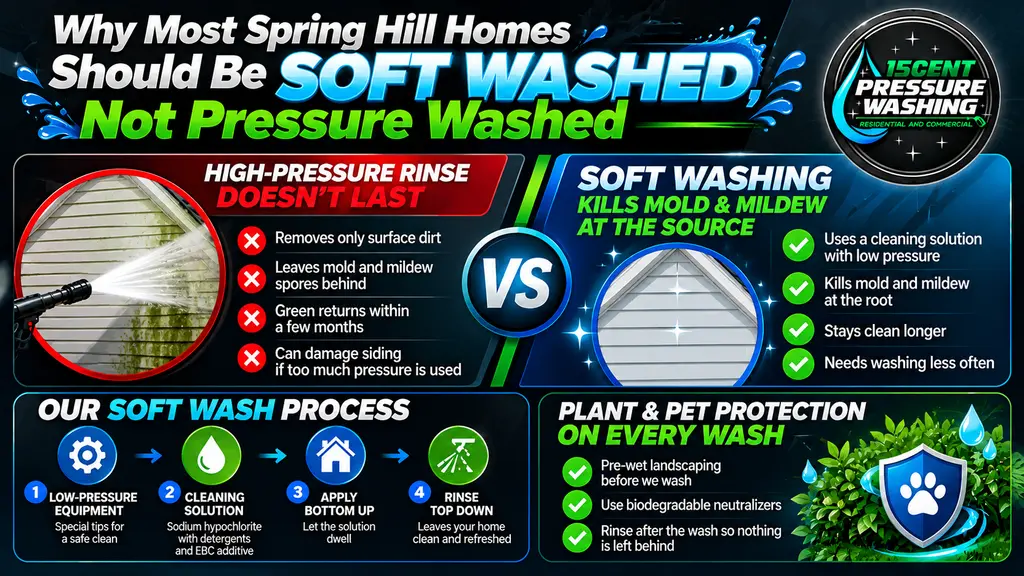
Soft washing kills mold and mildew at the source with a cleaning solution and low pressure, so a soft-washed house stays clean longer and needs washing less often than one that only gets a high-pressure rinse.
Why a pressure rinse doesn’t last
A high-pressure rinse knocks off what you can see but leaves the spores behind, and the green returns within a few months. As our owner puts it, it’s “very rare that we’re ever going to pressure wash a house.”
Washing too hard also does real damage. James Hardie warns that high-pressure washing can damage fiber cement, and says anyone using a pressure washer on its siding should stay under 1,500 PSI, keep at least 6 feet from the wall, and use a wide fan tip. The company also notes that damage from improper cleaning may not be covered by its warranty.
How we soft wash a house
We switch our machine to special low-pressure tips and let the cleaning solution do the work. The mix is sodium hypochlorite with detergents and an EBC additive that helps protect your siding’s color from fading and oxidation. We apply it from the bottom up, let it dwell, and rinse from the top down.
Plant and pet protection on every wash
Your plants shouldn’t die so your house can get clean. We pre-wet and treat your landscaping with biodegradable neutralizers before and after we wash, so nothing we use is left behind for your plants or your pets when we leave Spring Hill. This step is standard on every job, not an upgrade.
What Makes Some Spring Hill Homes Need Washing More Often?
Shade, nearby trees, siding type, and new construction are the four things that most often push a Spring Hill home from one wash a year to two.
Shade, north-facing walls, and hackberry trees
Walls that rarely see sun stay damp after every rain, which is exactly what mold and mildew need. Around here, hackberry trees are behind most of the roof stains we’re called about, and the same trees drop debris and keep nearby siding in shade. If your house sits under them, plan on a wash every six months.
Your siding type
We match the cleaning method to the surface. Hardie board gets scrubbed, brick mortar gets a stronger soft wash that reaches the mold deep in the joints, and metal homes get a specialty treatment that pulls out the dirt stains a hose never will. We’ve restored siding that painters told homeowners had to be repainted.
Vinyl rinses clean most easily. Brick is the one to watch, because mold hides deep in the mortar and can spread for a while before it shows from the street.
New construction and red clay dirt
Spring Hill’s population nearly doubled between the last two U.S. Census counts, from about 29,000 to about 50,000 residents, and many neighborhoods still have building nearby. Rain splashes clay dirt onto new siding, and crews track it onto porches and into garages.
A garden hose won’t move clay stains. We use a specialty treatment that pulls them out so they rinse away, and the best time to book is once the construction around you wraps up.
How Often to Clean the Rest of Your Home
Every exterior surface on your home runs on its own schedule: gutters need cleaning twice a year, windows about every six months, and a pre-treated driveway usually stays clean for two years or more.
| Surface | How often | How long results last (our experience) | What drives it |
|---|---|---|---|
| House siding (soft wash) | About once a year; every six months on shaded lots | Depends on shade and exposure | Shade, moisture, nearby trees |
| Roof (soft wash roof treatment) | When black streaks or moss return | Backed by our five-year warranty | Hackberry trees, shade, algae |
| Driveway and concrete | Every two years or more | Most customers get two or more years from a pre-treated cleaning | Shade, moisture, nearby trees |
| Deck and fence | When boards turn gray or green | Depends on wood type and sun | Shade, standing moisture |
| Gutters (no guards) | Twice a year, before and after fall | Until the next leaf drop | Overhanging trees |
| Gutters (with our stainless micro-mesh guards) | Inside cleaning rarely needed | About 10 years before the inside needs cleaning | Debris on top brushes off |
| Windows | About every six months; every three months on wooded lots | Four to five months | Pollen, pest-control spray, trees |
Roofs
Roofs follow the same rule as siding: no high pressure. The Asphalt Roofing Manufacturers Association says high-pressure washing is likely to damage asphalt roofing and shouldn’t be used to remove algae, and it notes that algae discoloration tends to come back after a cleaning.
Our soft wash roof treatment goes on at low pressure. Most roofs look new again before we leave. Heavy moss can take a month or two of rain to let go of the shingles completely. We let the treatment do that work instead of scraping or rinsing, because that strips the protective surface your shingles need.
Driveways, decks, and gutters
Driveways stay clean longer than siding because we pre-treat the mold living inside the concrete first; read more on why regular concrete cleaning matters. Wood is ready for deck restoration once boards gray or turn green, and our gutter cleaning and micro-mesh guards cover the rest.
Windows
We never spray windows with a pressure washer; our hand-detailed window cleaning is done entirely by hand. Get your windows cleaned every three months and save $25 to $50 on every visit.
When Is the Best Time of Year to Wash a House in Spring Hill?
The best time to wash a house in Spring Hill is late April through May, once spring pollen has finished falling, with a second wash in fall for homes on shaded or wooded lots. Washing during peak pollen buys days, not months, because a fresh coat lands right after the crew leaves.
| Time of year | What to do | Why |
|---|---|---|
| Late winter | Book your spring wash | Spring dates fill up first |
| Late April to May | Main house wash; a good time for windows too | Pollen is done, and the home starts summer clean |
| Summer | Catch-up wash if spring was missed | Heat and humidity make this peak mold season |
| Fall, after leaves drop | Second wash for shaded or wooded lots; gutter cleaning | Clears debris and growth before the wet winter months |
| Winter | Mild days only | Growth slows, and thunderstorms are the main weather stop |
We often keep working in light rain, but thunder and lightning stop the job until we can reschedule. Spring Hill winters are mild, so a mild winter day works when growth can’t wait.
Signs Your House Is Due for a Wash
Your house is due for a wash when you see green or black streaks on the siding, dark spots in the brick mortar, or a dull film on the shaded side of the house. Watch for these:
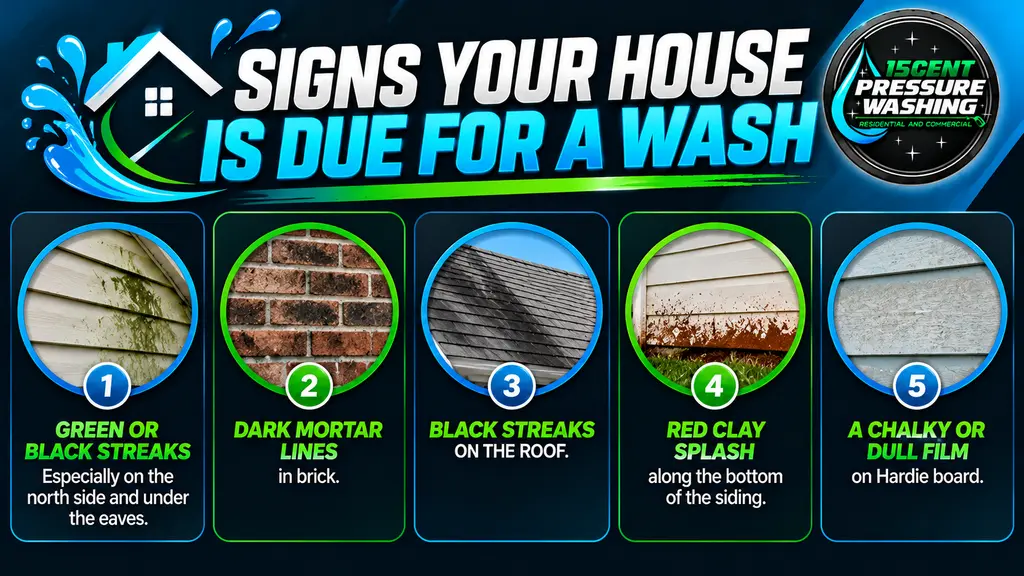
- Green or black streaks, especially on the north side and under the eaves
- Dark mortar lines in brick
- Black streaks on the roof
- Red clay splash along the bottom of the siding
- A chalky or dull film on Hardie board
Growth that sits for a season or two works deeper into the surface and takes more to remove. We cover the longer-term costs in our post on what happens when you skip routine washing.
What Does Regular House Washing Cost in Spring Hill?
House washing in Spring Hill starts around $450 for a 2,000-square-foot single-story home, and every job carries a $400 minimum per visit. Larger and multi-story homes run higher, and Hardie board that needs hand scrubbing or heavily molded brick adds to the cost.
Pairing surfaces in one visit gets more done for the minimum, so ask about bundle savings when you add your driveway to a house wash. Military households get 5% off, and you can ask about our current specials when you call. Our full Spring Hill pricing guide breaks down every service.
Spring Hill House Washing FAQs
How long does a house wash take in Spring Hill?
Most house washes in Spring Hill take two to four hours, and many single-story homes finish in about two. Our guide to how long each service takes covers roofs, driveways, and gutters too.
What should you never do when washing a house?
Never put a high-pressure tip on siding, windows, or a shingle roof, and never spray up under the laps of your siding, where water can get behind it. Don’t let cleaning solution dry on the surface or run into unprotected plants. We also photograph your whole property before we start, so we both know exactly what it looked like when we arrived.
My HOA sent a notice about mildew on my house. What should I do?
Check the deadline in your HOA notice and book a wash before it runs out, since these notices usually give a set window to fix the problem. If neighbors on your street got notices too, ask about our exterior cleaning for HOA communities, which lowers the price per home when we clean several in one visit.
Should I wash my house before painting or selling it?
Yes. Paint bonds better to clean siding, and a clean exterior shows better in listing photos. Get a wash quote before you book a painter, since siding that looks like it needs paint sometimes only needs the right cleaning. We go into more detail in our post on washing your home before you sell.
Do you need my water?
We usually connect to your outdoor spigot. No water on site? We can bring our own. Hauling water adds to the price based on how many tanks the job needs.
Not Sure What Schedule Your Home Needs?
Once a year works for most homes here, and every six months suits shaded lots, timed after pollen season. If you’re not sure which group your house falls into, we’ll look at your lot, siding, and shade during a free on-site estimate and tell you what we’d recommend. Call (931) 446-1031 or request a free estimate online. Your satisfaction is 100% guaranteed.
