
Most advice online says spring is the best time to wash a house. In Spring Hill, that answer needs a date attached, because spring here is also when Middle Tennessee gets buried in tree pollen. If you’ve watched a yellow film settle on your car in late March, you already know a house washed that week won’t stay clean for long.
One more thing up front: we don’t pressure wash houses. As our owner puts it, it’s “very rare that we’re ever going to pressure wash a house.” Siding gets a soft wash, where low pressure and the right cleaning solution do the work. So the real question isn’t when your house can handle a cleaning. It’s when the result will last the longest.
The Best Months to Wash a House in Spring Hill
For most Spring Hill homes, the cleanest, longest-lasting house wash comes in late April through May, after tree pollen stops falling, or in October and November, once most leaves are down. You can wash a house in almost any month here. The table shows what lands on your siding through the year and how a fresh wash holds up.
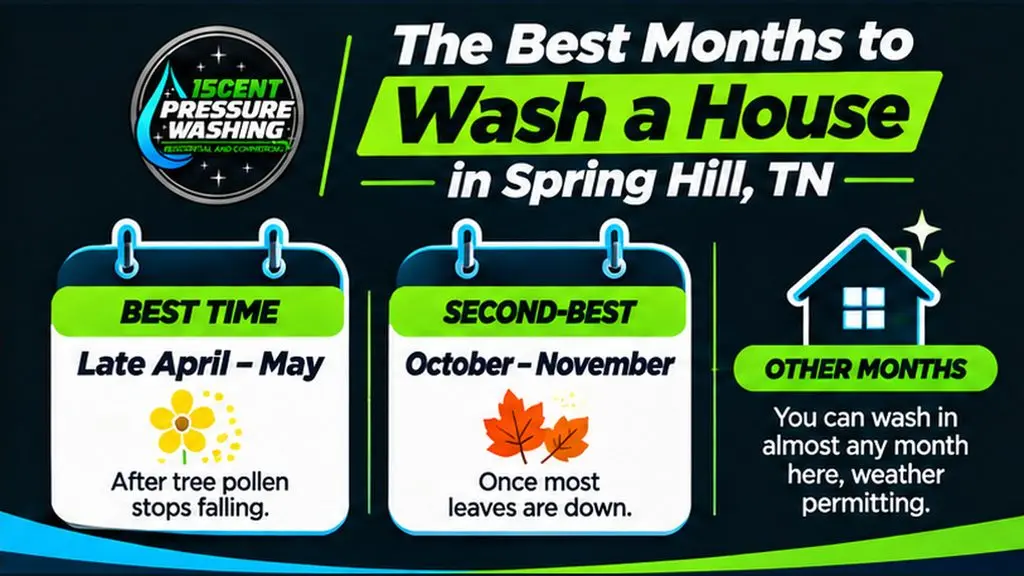
Temperatures are average highs and lows from U.S. Climate Data. The average last spring frost lands around April 10 and the first fall frost around October 27, based on the Old Farmer’s Almanac’s frost dates from NOAA climate records.
Whichever month you pick, our soft wash house washing follows the same steps. We protect your plants first, apply the cleaning solution from the bottom up, let it dwell, and rinse from the top down.
Why Early Spring Backfires in Middle Tennessee
Early spring is a poor time to wash a house in Spring Hill because Middle Tennessee’s tree pollen peaks from mid-March into late April and settles right back onto clean siding.
According to WSMV 4 in Nashville, tree pollen season at this latitude starts in early to mid-February, peaks from mid-March into the fourth week of April, and then winds down. National guides call mild spring weather ideal for washing. Here, that mild weather lands right on top of the heaviest pollen of the year, and a house washed during the peak can look yellow again within days.
The same timing applies to glass. We recommend window cleaning around May, once pollen season is done.
Why Fall Is the Second-Best Window
Fall is the second-best time to wash a Spring Hill house because the weather is mild and dry, and it works best after most leaves have dropped and hackberry trees have finished dripping.
Hackberry trees are behind most of the roof stains we’re called about around here, and they make a mess of siding, patios, and cars too. The Asian woolly hackberry aphid feeds on these trees and drips sticky honeydew onto whatever sits below, where black sooty mold grows on it, according to the Tennessee Department of Agriculture’s Protect TN Forests program. A University of Tennessee and Tennessee State University Extension column in the Spring Hill paper notes the sooty mold is most visible in the fall.
If your home sits under hackberries or heavy tree cover, book the fall wash after most of the leaves are down. That’s also the right time for the second gutter cleaning of the year.
The Best Time for Each Surface Around Your Home
Each exterior surface on a Spring Hill home has its own best timing: windows after pollen season, gutters before and after leaf fall, roofs and driveways almost any time, and sealing only during a dry stretch.
| Surface | Best time in Spring Hill | Why | How we handle it |
|---|---|---|---|
| House (siding, brick, metal) | Late April–May; again October–November | After the pollen peak; after leaf drop | Soft wash matched to the siding, with plants protected before and after |
| Roof | Any time of year | Rain finishes the treatment | Low-pressure treatment applied from the roofline, with neutralizer pods in the gutters; shingles left unrinsed |
| Windows | Around May, after the house wash | Pollen season is done, and no runoff lands on clean glass | Cleaned by hand inside and out, with tracks vacuumed and screens hand-washed |
| Gutters | Before fall, and again after leaves drop | Most leaves come down in fall | Cleaned by hand, debris bagged, before-and-after photos sent to you |
| Driveway and concrete | Year-round | Pre-treatment kills mold spores below the surface | Pre-treated, then surface-cleaned with the joints rinsed |
| Driveway sealing | A dry stretch in late spring or early fall | Sealer needs a fully dry surface | Cracks filled first, then sealer rolled on |
| Deck and fence restoration and staining | A dry stretch in spring or fall | Stain needs dry wood | Two-step cleaner and brightener; stain sprayed, then back-brushed |
| Holiday lighting | Book in early fall | Install and takedown are scheduled together | Custom-fit lights, taken down after New Year’s |
Houses get the most attention in that table for a reason. We match the cleaning method to the surface. Hardie board gets scrubbed, brick mortar gets a stronger soft wash that reaches the mold deep in the joints, and metal homes get a specialty treatment that pulls out the dirt stains a hose never will. We’ve restored siding that painters told homeowners had to be repainted.
Roofs are the one job where rain helps. We treat shingles at low pressure and don’t rinse them, because rinsing strips the protective surface your shingles need, and the next good rain washes the solution away. Most roofs look new again before we leave. Heavy moss can take a month or two of rain to let go completely, and every roof cleaning is backed by our five-year warranty.
Windows come last in the spring lineup. Our hand-detailed window cleaning covers glass inside and out, plus tracks and screens. Homes on wooded lots can get their windows cleaned every three months and save $25 to $50 on every visit.
Driveway sealing takes the most patience. The concrete has to be clean and completely dry, since sealing over moisture leaves a milky haze. Many concrete sealer manufacturers also call for temperatures above about 50 degrees and no freezing for 24 hours after application, which points to late spring or early fall. To check whether your driveway needs resealing, pour a cup of water on it. If the concrete soaks it up, it’s time.
What Order Should Exterior Cleaning Happen In?
The right order for exterior cleaning depends on which services your home needs, so if you’re booking more than one, ask us how to sequence them when we quote. The goal is that nothing we clean gets dirty again from the next job, like runoff from the roof landing on freshly cleaned windows.
When You Shouldn’t Wash Your House
Thunder and lightning stop a professional house wash in Spring Hill, and it’s also smart to avoid washing when temperatures will drop below freezing before surfaces dry, since water left on walkways and steps can turn to ice.
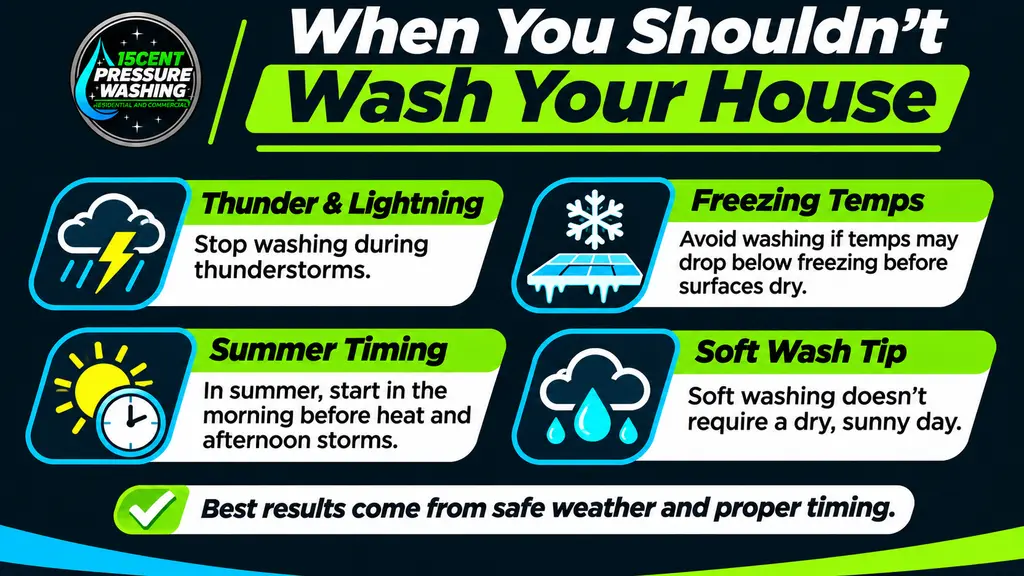
Summer has one more catch. On hot afternoons, cleaning solution dries faster on sun-baked walls, so summer washes are best started in the morning. Afternoon thunderstorms are common here from June through August, and a summer job may pause and pick back up once a storm passes.
Many online guides tell you to wait for a dry, sunny day. That makes sense if you’re using a pressure washer yourself, but a soft wash doesn’t need one.
Can You Wash a House in the Rain?
Yes, a professional soft wash can continue through light rain, and our crews often keep working through it. Rain even helps with roofs, since it’s what rinses a roof treatment away.
Is Spring or Fall Safer for Your Plants?
Neither spring nor fall is safer for your plants on its own. What protects your landscaping is how the cleaning crew treats it before and after the wash.
Plenty of homeowners around here have lost shrubs and flower beds after a house wash, and some companies tell them it’s part of the process. That loss isn’t part of a proper wash.
The steps stay the same in every season, whether your beds are bare in March or in full leaf in July.
Timing for Sellers, New Builds, and HOA Notices
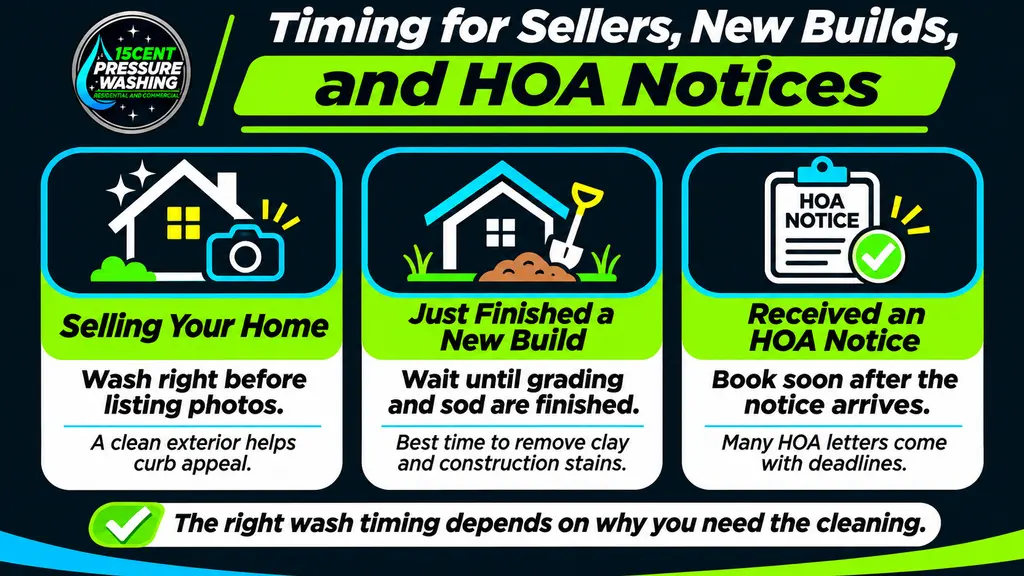
If you’re selling, just finished building, or got an HOA letter, the timing shifts: wash right before listing photos, after the yard is finished, or soon after the notice arrives.
Selling Your Home
Book a house wash right before your listing photos are taken. HomeLight’s survey of top real estate agents found buyers pay about 7% more for a home with excellent curb appeal. Spring listing season overlaps the pollen peak, so a March listing may need its wash scheduled close to photo day.
Just Finished a New Build
Wait until final grading and sod are in place, so rain doesn’t splash fresh clay right back onto new siding. Spring Hill grew from 50,689 residents at the 2020 Census to an estimated 61,946, according to the Middle Tennessee Industrial Development Association, and plenty of that growth is new construction. Our post-construction cleanup uses a specialty chemical that pulls clay stains out so they rinse away, and we can usually still get them out even after someone has tried to pressure wash them.
Received an HOA Notice
Book soon after an HOA letter arrives, since many notices set a deadline. For HOA communities, pricing is based on our house washing rates, with lower pricing when we clean multiple homes in one visit.
Frequently Asked Questions
How many times a year should you wash your house in Spring Hill?
Most Spring Hill homes do well with one house wash a year, timed for late April or May. Homes under heavy tree cover, especially hackberries, or with shaded walls that stay damp, often need a second wash in fall. Our guide to how often to wash your home covers the signs that it’s time.
How long does it take to wash a 2,000 sq ft house?
Most house washes take two to four hours, depending on the size of the home, the number of stories, and the siding. Hardie board that needs hand scrubbing and brick with heavy mold in the mortar take longer. Our breakdown of how long exterior cleaning takes in Spring Hill covers driveways, decks, and other surfaces.
What hours do your crews work?
Our crews work from 8 a.m. to 8 p.m., seven days a week, on residential jobs. Commercial properties can be scheduled after hours or overnight, so customers never have to walk around us.
How far ahead should I book for the spring window?
Reach out once the pollen starts to taper off in April. We respond to every request within 24 hours and set a date that works for you.
Can I add my driveway or windows to the same visit?
Yes, you can add a driveway, walkways, or windows to a house wash visit. Each surface is quoted separately, so your quote lists exactly what we’re cleaning, and you can ask about bundling services when we quote.
For a sense of how each surface is priced, see our guide to what pressure washing costs in Spring Hill.
Ready to Get on the Schedule?
Not sure whether your house can wait until May? Call us at (931) 446-1031 or email contactus@15centpressurewashing.com, and we’ll come out for a free estimate and help you pick the right time. We respond to every request within 24 hours, and military customers save 5%.
